How to Write Product Descriptions That Persuade Shoppers to Buy
A product description sells when it speaks to one specific buyer, turns features into concrete benefits, answers likely objections and ends with a clear reason to act. It does all of this in plain, scannable language that a shopper can absorb in seconds.
That is the core of how to write product descriptions that work. The rest of this article turns it into a repeatable process.
What a description is for
A description does the job a salesperson would do in a shop. It helps the shopper picture the product in their life, removes doubt, and makes the next step feel easy. Shoppers can't touch the item, so your words stand in for their hands and eyes.
Why a spec list isn't enough
A spec list states facts: "600 ml, stainless steel, double-walled." A description explains what those facts mean: "Keeps water cold through a long commute, and won't leave your bag damp." The specs still matter, since buyers use them to compare and confirm, but they answer "what is it?" and not "why should I want it?"
The framework at a glance
This product description framework has five steps:
- Define your buyer.
- Gather the facts and the questions buyers ask.
- Turn features into benefits.
- Choose specific, sensory language.
- Structure the copy so it gets read.
Each step feeds the next, so work through them in order. Later sections show every step in practice, including rewrites of weak descriptions.
Step 1 and 2: Define Your Buyer and Gather the Facts
Step 1: Define your buyer
Pick one target customer and write to them. A description aimed at "everyone" tends to persuade no one.
Describe that person in a few lines: what they do, what problem they have, and what they've likely tried already. For a stainless steel bottle, it might be a commuter who is tired of leaky bags, not "anyone who drinks water."
Useful prompts:
- Who buys this, and who are they buying it for?
- What are they trying to fix or enjoy?
- What words do they use? Check reviews, emails and support chats.
Step 2: Gather the facts
Collect every detail before you write a word. Gaps are easier to spot on a list than in finished copy.
- Product features: what it does, how it works, what's included.
- Materials and build: fabrics, metals, finishes, care instructions.
- Dimensions and weight: exact measurements, plus sizing notes.
- Use cases: where, when and how people use it.
Then list the questions and objections buyers raise before purchase. Mine customer service inboxes, product reviews and competitor Q&A sections. Typical ones include "Will it fit?", "Is it dishwasher safe?", "What if it doesn't suit me?" and "Why does it cost more?"
Keep this list beside you. Each objection is something the finished description should answer.
Step 3 and 4: Turn Features Into Benefits and Choose Sensory Language
Step 3: Turn features into benefits
Features and benefits are two halves of one sentence. The feature is what the product has. The benefit is what that does for the buyer. Link them with a quiet "so" or "which means."
Take each fact from your list and ask, "So what?" until you reach something the buyer cares about:
- Double-walled steel: keeps drinks cold, so water is still refreshing at the end of the commute.
- Wide mouth: fits ice cubes and a cleaning brush, so washing is easy.
- Machine-washable cover: spills stop being a worry.
Stop when the answer is tied to your buyer from Step 1. A commuter cares about a dry bag, while a hiker may care about weight. Only claim benefits the product delivers. If you haven't tested the "all-day" cold, don't promise it.
Step 4: Choose sensory language
Vague adjectives such as "high-quality," "amazing" or "premium" tell shoppers nothing. Replace them with details they can see, hear, feel or smell.
- Instead of "soft blanket," try "brushed fleece that feels warm the moment you pull it on."
- Instead of "great scent," try "notes of cedar and orange peel."
Keep it honest. Describe only what the product really is, and use measured facts you actually have. Vivid wording should clarify, not inflate.
A quick test for persuasive copy: could a competitor paste your sentence onto their product? If so, it's too generic. Add the specific detail that only your item has.
Step 5: How Do You Structure a Description So It Gets Read?
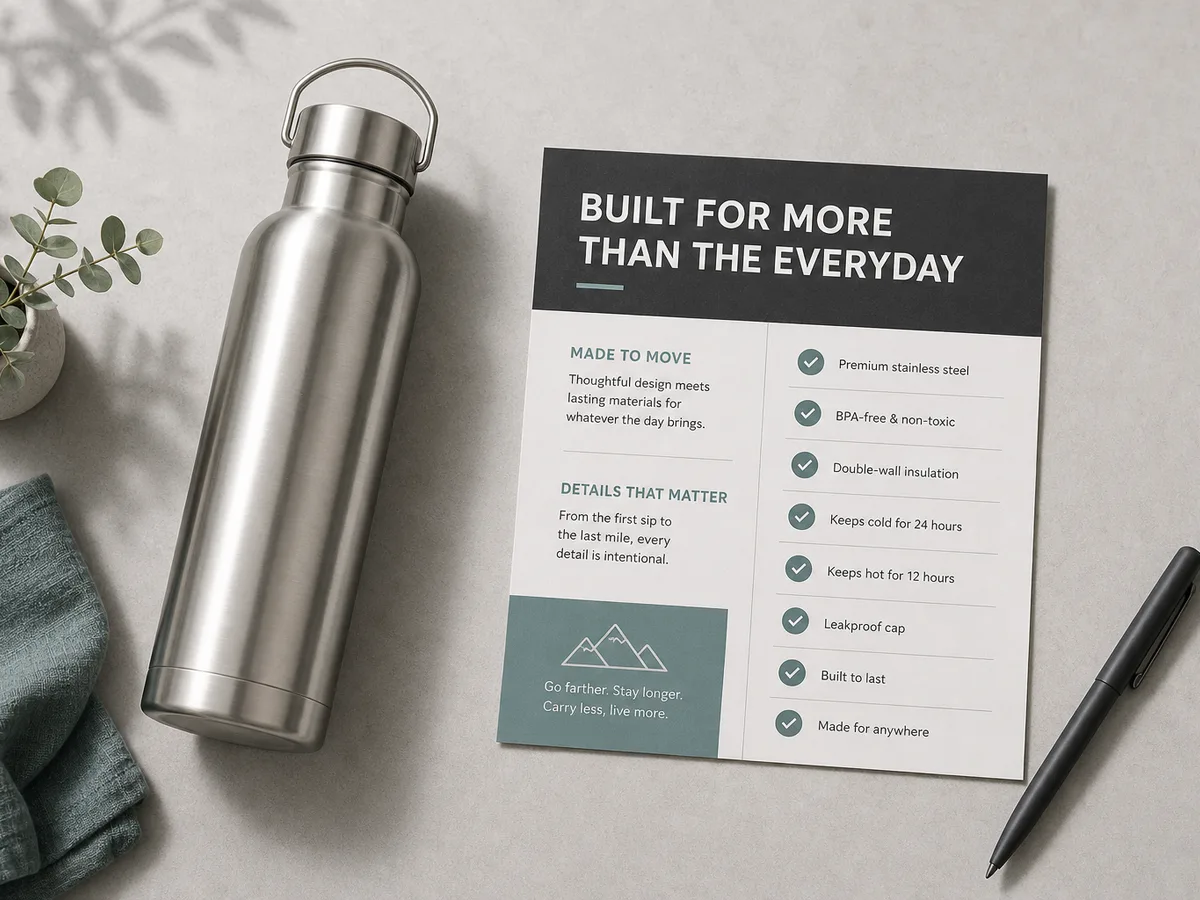
Structure a description in four parts: a strong opening line, a short benefit paragraph, bullet points for specs, and a closing nudge. This order gives skimmers the hook first and the details second. A scannable layout lets shoppers decide in seconds whether to keep reading.
Open with the payoff
Lead with the single most compelling outcome for your buyer from Step 1. "Keeps water cold through your whole commute" beats "Introducing our new bottle." Put the product's plain name and its main benefit in the first sentence.
Follow with a short benefit paragraph
Use two to four sentences to link your best features to outcomes, using the sensory wording from Step 4. Answer one or two top objections here, such as leaks or weight.
Put specs in bullets
Bullets suit facts that people compare or check:
- Size, weight and capacity
- Materials
- Care instructions
- What's included
Keep each bullet to one idea, and put the detail buyers care about most first.
Close with a nudge
End with one clear reason to act, such as a fit reassurance, a returns note or a simple "Add to cart to..." line. Only mention policies that are true.
Place search terms naturally
Good product page SEO starts with the title. Put the main phrase a shopper would type, such as "insulated stainless steel water bottle," near the front, followed by a distinguishing detail.
Then:
- Use the main phrase once in the opening line.
- Use related terms, such as "double-walled" or "leakproof lid," where they fit the sentence.
- Read the copy aloud. If a phrase sounds forced, cut it.
Repeating a keyword for its own sake hurts readability, and readability sells.
Before-and-After Rewrites: Three Weak Descriptions Made Stronger
These three product description examples show how one rewrite can fix one clear weakness. The details in each revision are illustrative, so swap in your own verified facts.
Water bottle
Before: "High-quality bottle. Great for everyone. Keeps drinks fresh."
After: "Built for the commute. The double-walled steel keeps water cold for hours, and the leak-resistant lid means no damp laptop bag. It fits most cup holders."
Fix: Step 3, features into benefits. "High-quality" became a specific outcome the buyer cares about.
Candle
Before: "A amazing candle with a lovely scent. Perfect gift."
After: "Light it after dinner and the room fills with warm cedar and a hint of vanilla. Hand-poured soy wax, with a cotton wick for a steady, even burn."
Fix: Step 4, sensory language. "Amazing" and "lovely" said nothing, so concrete scents and materials replaced them.
Backpack
Before: "Spacious backpack with many pockets. Durable and stylish."
After: "Made for students and commuters who carry a laptop daily. A padded sleeve holds up to a 15-inch laptop, and a water-resistant fabric helps in light rain. Not sure it fits? Dimensions are listed below."
Fix: Steps 1 and 2, buyer and objections. Naming the buyer and answering the sizing question made the copy specific.
Notice what each rewrite avoids: no invented claims, only details you can confirm.
A Final Checklist to Review Any Product Description Before Publishing
Run this editing checklist before you publish any description. If an item fails, fix it first.
- Accurate: Do the sizes, materials and claims match the product exactly? Remove anything you can't back up.
- On tone: Does it sound like your brand and speak to your one buyer?
- Objections answered: Are fit, care, shipping and returns questions covered or clearly linked?
- Readable: Are the paragraphs short, the specs in bullets, and the vague adjectives gone? Read it aloud to catch clumsy lines.
- Clear call to action: Does the last line tell shoppers what to do next, such as "Add to cart" or "Choose your size"?
Once it's live, treat it as a draft you can improve. Change one element at a time, such as the opening line or the call to action, and compare results over a reasonable period before keeping the winner.