How to Edit Your Own Writing: The Short Answer
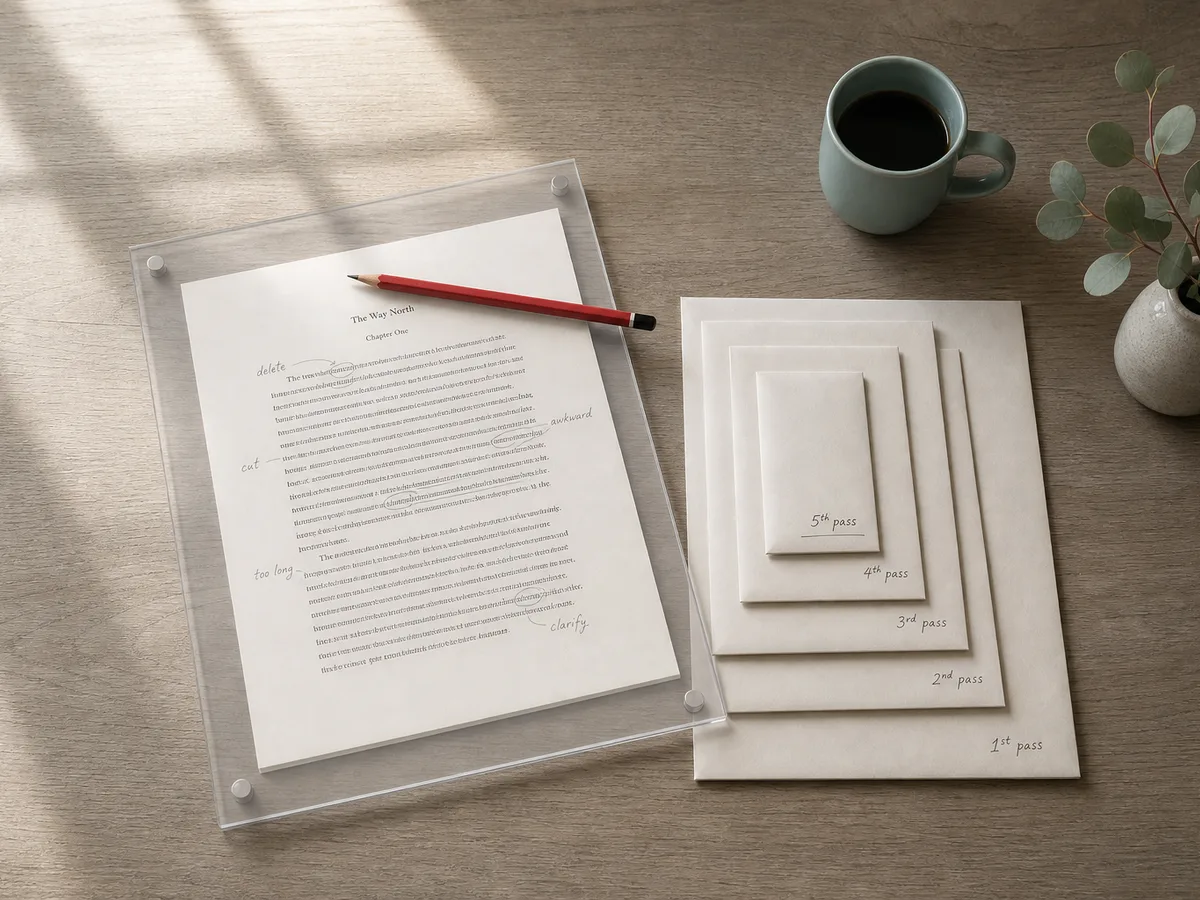
To edit your own writing, let the draft rest, then work in separate passes: first structure and argument, then paragraph clarity, then wordiness, then style, and finally proofreading. Fixing big problems before small ones keeps you from polishing sentences you may later cut.
Self-editing is hard because you know what you meant. Your brain fills gaps, skips missing words, and reads the idea you intended instead of the words on the page. You are also attached to your own phrasing, so cutting a clumsy paragraph feels like losing something, even when the reader would never miss it.
Trying to fix everything at once makes this worse. You fix a comma in a paragraph that should be deleted, or you miss a broken argument because you were hunting typos.
What distance does
Distance turns you from the author into a reader. A rested draft, a new format, or a read-aloud pass lets you notice what is unclear, repetitive, or missing. You don't need to become a different person, only to see the page less automatically.
The five passes at a glance
This self-editing process moves from large to small:
- Structure: check the argument, order, gaps, and repetition.
- Clarity: make each paragraph carry one idea.
- Concision: trim filler and padded phrasing.
- Style: refine word choice, rhythm, and tone.
- Proofreading: catch errors in grammar, spelling, and formatting.
Each pass has one job, which keeps the work manageable.
Prepare Before You Edit: Create Distance and Set a Goal
Before you change a word, give yourself a way to see the draft as a stranger would.
Rest the draft
Put it away for a while. A few hours helps, a night is better, and a longer break is better still if your deadline allows. How much you need depends on how close you are to the text. The aim is to forget your intended phrasing, so that the page, not your memory, tells you what it says.
Change how you see it
Fresh eyes come more easily when the draft looks different. Try one of these:
- Print it, or move it from your editor into a PDF.
- Change the font, size, or margins.
- Read it on a phone or tablet instead of your laptop.
Then try reading aloud. Your mouth catches what your eyes skip: missing words, tangled sentences, and runs of the same sound or structure. If you stumble or run out of breath, the reader probably will too. Mark those spots and keep going rather than fixing them mid-sentence.
Set the standard first
Edits need something to be measured against. Write two lines before you start:
- The reader: who they are, what they already know, and what they need from this piece.
- The purpose: one sentence saying what the piece should make the reader understand, decide, or do.
For example: "Help new managers run a first one-on-one," not "Talk about management."
Keep these lines visible. When you doubt a paragraph, ask whether it serves that reader and that purpose. If not, it is a candidate for cutting, however well written it is.
Passes One and Two: Fix Structure, Then Sharpen Clarity
Pass one: fix the structure
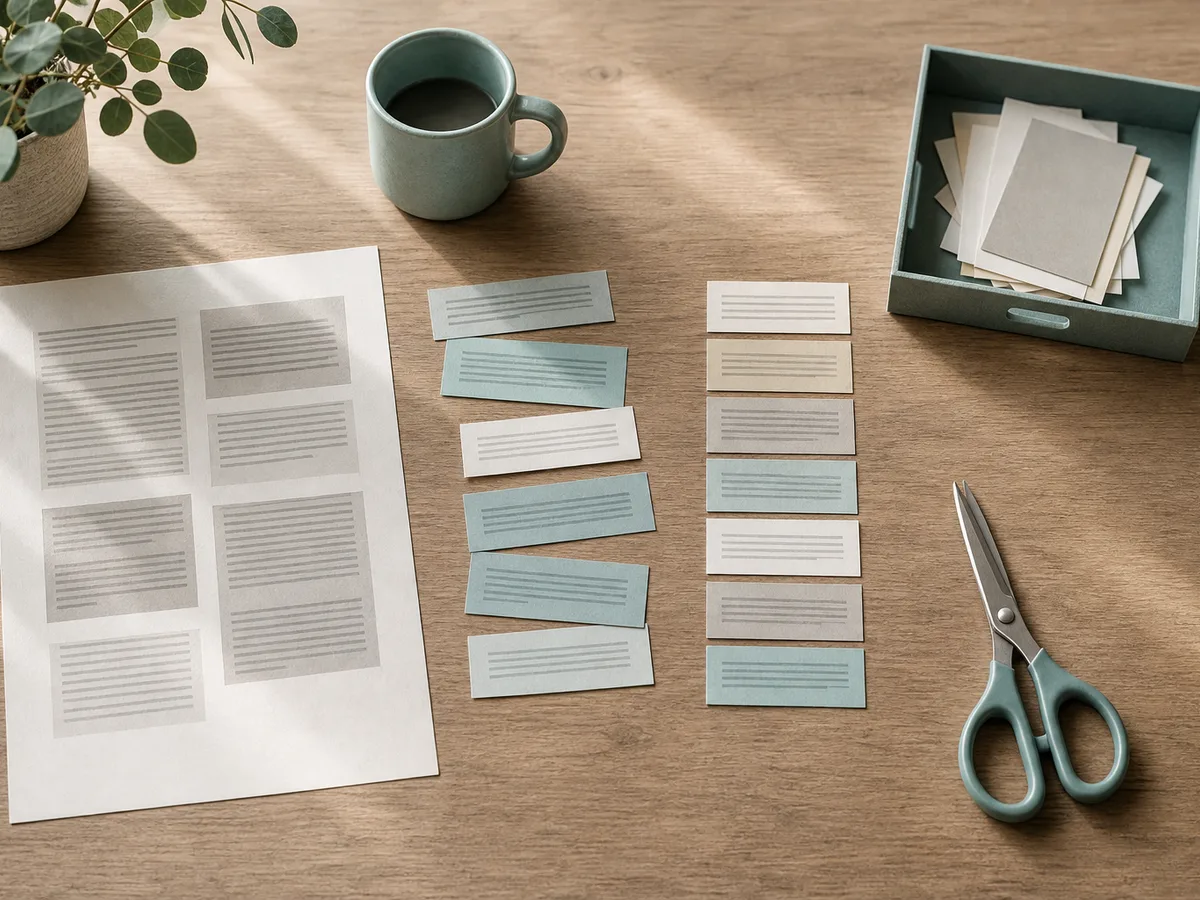
A structural edit asks whether the piece works as a whole. Ignore sentences for now. Work at the level of sections and blocks.
Start by writing a one-line summary of each section, or a reverse outline. Then read the list as if it were the piece itself. You will often spot problems at once:
- Argument: Does each section support your main point, or does one drift off?
- Order: Would the reader need something from a later section to understand this one?
- Gaps: Is a step, example, or piece of evidence missing between claims?
- Repetition: Do two sections make the same point in different words?
Then act. Move blocks that sit in the wrong place. Merge sections that repeat each other. Cut anything that doesn't serve the purpose you set earlier, even if it is well written. Put a cut paragraph in a separate "leftovers" file, which makes deleting it feel less like a loss.
Pass two: sharpen clarity
Now move down to the paragraph. Paragraph clarity comes from a simple rule: one paragraph, one idea.
Read each paragraph and ask what its single point is. If you need "and also" to answer, split it. If you can't answer at all, the paragraph probably needs rewriting or cutting.
Then check these elements:
- Topic sentence: Does the opening line state the point, or does the reader have to hunt for it?
- Transitions: Does each paragraph connect to the one before it, through a link in logic and not just "Moreover"?
- Vague claims: Replace phrases like "many people struggle" or "this can help a lot" with a specific example, condition, or explanation.
- Order within the paragraph: Put the claim first, then support, then any consequence.
A quick test: read only the first sentence of every paragraph. If the thread of your argument holds, the topic sentences are doing their job. If it doesn't, fix those lines first.
Passes Three and Four: How Do You Cut Wordiness and Polish Style?
Pass three is where you cut wordiness; pass four is where you shape what remains so it sounds like you. Keep them separate. Trimming asks "does this earn its place?" Polishing asks "does this sound right?"
Pass three: trim the padding
Read each sentence and ask what would be lost if you deleted it, then each phrase. Look for these common offenders:
- Filler words: very, really, just, quite, actually, basically. Most can go without a trace.
- Redundant pairs: "each and every," "plan ahead," "final outcome."
- Padded constructions: "due to the fact that" becomes "because"; "in order to" becomes "to"; "there are many people who believe" becomes "many people believe."
- Throat-clearing openers: "It is important to note that" usually introduces a sentence that can stand alone.
- Buried verbs: "make a decision" is "decide"; "conduct an analysis of" is "analyze."
Do not trim by rule alone. A "just" or "actually" sometimes carries real tone. Cut it when removing it changes nothing.
Pass four: refine the style
Now work on word choice. Swap vague words for specific ones, and replace abstract phrases with an example where you can.
Prefer active voice when the actor matters: "The team missed the deadline" is clearer than "The deadline was missed." Passive is fine when the actor is unknown or beside the point.
Check sentence rhythm by reading aloud. If every sentence runs the same length, the prose drones. Follow a long sentence with a short one. Split a sentence that makes you run out of breath. Join two choppy ones that belong together.
Then check tone. A casual aside in a formal report, or stiff phrasing in a friendly post, jars the reader.
Protect your voice. If an edit makes the sentence correct but unlike you, undo it. The aim is a clearer version of how you write, not a generic one.
Pass Five: Proofread Line by Line for Errors
Proofreading comes last because every earlier pass changes the text. Fix errors before then and you will only introduce new ones. Slow down here: you are checking surfaces, not ideas.
Techniques that break autopilot
Your brain autocorrects familiar text, so change how it looks.
- Read backward. Start at the last sentence and move up. Without the flow of meaning, misspellings and doubled words stand out.
- Change the display. Print the draft, or switch the font, size or background color.
- Point as you read. Use a finger or cursor to keep your eyes on each word.
Use a proofreading checklist
Build a proofreading checklist from your own habits, then check one item per sweep:
- Spelling, especially homophones such as "their" and "there"
- Punctuation: commas, apostrophes, quotation marks
- Names, titles, numbers and dates against your source
- Links: click each one
- Formatting: heading levels, bullet style, spacing, capitalization
Single-item sweeps feel slow, but they catch more than one general read.
Know when to hand it off
If the piece will be published, sent to a client or carries your reputation, ask someone else for a final read. Fresh eyes see what yours cannot. Tell them to look for errors only, so they don't reopen the structure you settled earlier.