
How to Write a Case Study: The Short Answer
To write a case study, pick a customer your target buyers will recognize, interview them for specifics, and tell a short story of challenge, solution and measurable result. Put the outcome first, in the headline and the opening lines, so a skimming reader sees the payoff immediately.

The goal is to help a prospect picture themselves getting the same result. The reader is a buyer weighing a decision, not someone who wants to hear about your product.
The steps, in order:
- Choose a customer story worth telling.
- Interview the customer with questions that draw out detail.
- Plan a structure that keeps skimmers moving.
- Write the headline and snapshot around the outcome.
- Tell the challenge, solution and results as a story.
- Add quotes, visuals and clean formatting.
- Get sign-off, then put the story to work.
The rest of this article walks through each step. It includes interview questions grouped by stage and a fill-in-the-blanks template you can reuse for every customer.
Why Most Customer Case Studies Go Unread
Most customer case studies go unread because they are written for the vendor, not the buyer. They open with the company's history, praise the product's features and bury the result in the final paragraph.
Four failures show up again and again:
- Vendor-centric writing: the product is the hero, and the customer is a prop.
- Buried results: the payoff sits below the fold, so skimmers leave first.
- Vague claims: "improved efficiency" or "a seamless experience" give a buyer nothing to judge.
- Walls of text: long blocks with no subheads or quotes look like work.
A buyer scanning a customer case study is asking three quick questions:
- Is this a company like mine?
- Did they have a problem like mine?
- Is the outcome believable?
If the page answers none of these within seconds, it gets closed.
Choose a Customer Story Worth Telling
Not every happy customer makes a good customer success story. Screen candidates against four criteria:
- Relevance: They look like the buyers you want next, in size, industry or role.
- A clear before-and-after: The problem was visible and the change is easy to describe.
- A plainly stated result: You can say it in one sentence, such as time saved or revenue gained.
- A named champion: Someone willing to be quoted and credited.
To make the request, ask the person who values your work most. Be specific: a 30-minute call, a draft for their approval, and how the story will be used. Offer to do the writing, and mention what they gain, such as visibility for their team's work.
What Questions Should You Ask in a Customer Interview?
Ask open questions that follow the customer's story in order. Good customer interview questions invite a scene or a number, not a verdict.
- Before: What did a normal week look like? What was the problem costing you in time, money or frustration?
- Decision: What made you start looking? Why then, and not earlier?
- Evaluation: What else did you consider? What worried you? What tipped the choice?
- Implementation: How did the first weeks go? What surprised you? Who had to be convinced?
- Results: What changed? How do you measure it? What would you tell a peer in your position?
To draw out specifics, keep asking "Can you give me an example?" and "What did that look like day to day?" For quotable language, try "How would you describe this to a colleague?" or "Before, we… now we…"
Ask permission to record, and get a transcript so you quote accurately.
Afterward, email a short follow-up to confirm figures, dates, names and job titles. Ask for any numbers they missed.
The Structure That Keeps Readers Moving
A reliable case study structure follows the order a buyer's questions arise. Each part answers one question and gives a skimmer a reason to keep going.
- Headline: names the customer and the result. It answers "is this relevant to me?"
- Snapshot: a short box with company, challenge and outcome. A reader who stops here still gets the gist.
- Challenge: the problem before the change. Buyers look for their own situation here.
- Solution: why the customer chose you and how it was put in place. This makes the result believable.
- Results: the measurable outcome, with context.
- Customer quote: a human voice that confirms the claim.
- Call to action: one clear next step for a reader who is convinced.
Keep the order fixed across every story. Readers learn where to look, and you spend less time deciding how to organize each one.
Lead With the Outcome: Headline and Snapshot
A strong case study headline names the customer and the result in one line, such as "How [Customer] Cut [Problem] by [Result] with [Product]." Use only a figure the customer confirmed.
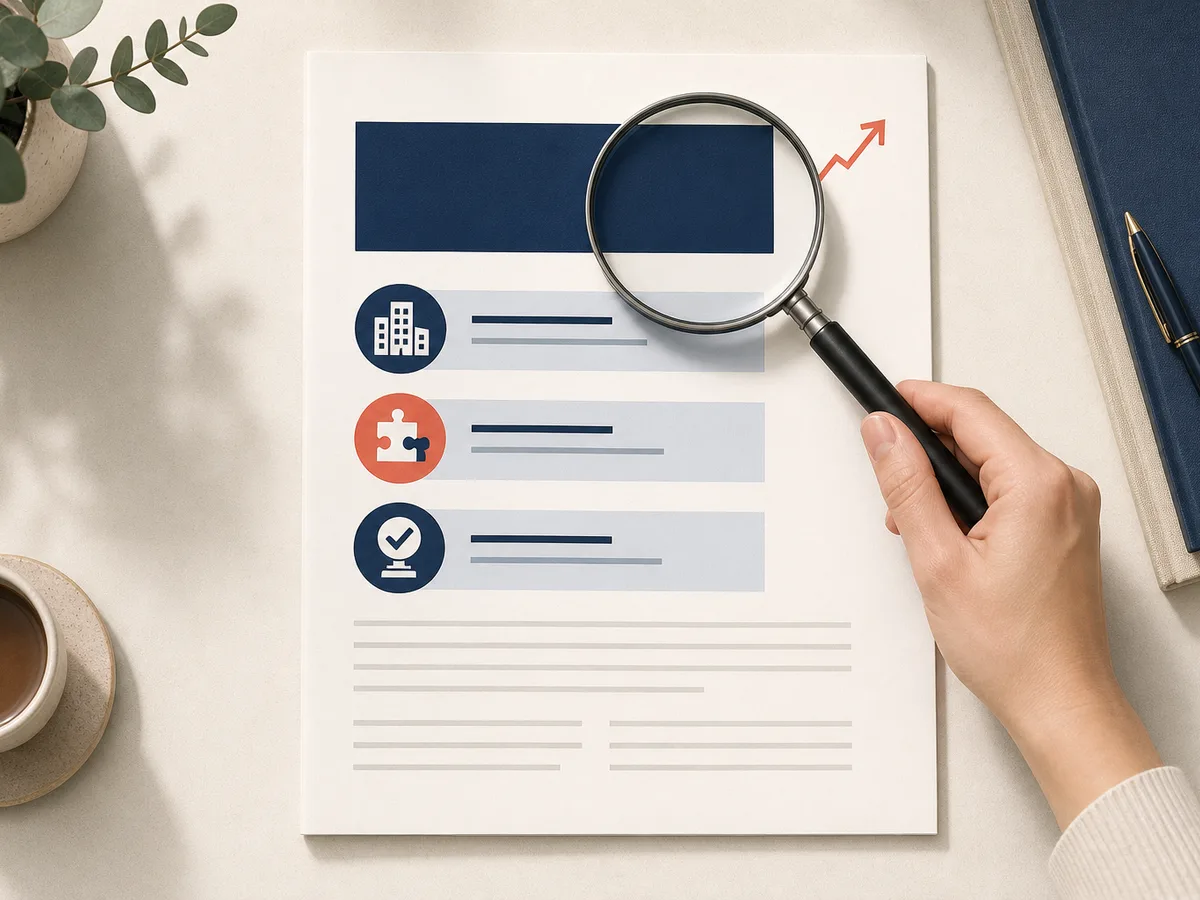
Under it, add a three-line snapshot:
- Company: industry and size
- Challenge: the problem in one sentence
- Outcome: the main result
Skimmers get the story without scrolling.
Tell the Challenge, Solution and Results as a Story
Write the body as three beats.
Challenge: Describe the problem in the customer's own words, with the cost of leaving it unsolved.
Solution: Explain why they chose you over alternatives, then how rollout went, including any snags.
Results: Give outcomes with context: the baseline, the timeframe, and who measured them.
If numbers are limited, state what changed, use a quote, or give a range you can verify. Never invent a figure.
A Fill-in-the-Blanks Case Study Template
Copy this case study template for each new customer. Replace the brackets and delete any block you can't fill with specifics.
1. Title (8-15 words) [Customer] [achieved result] with [your product or service]. Name the customer and the outcome.
2. Snapshot (3-4 short lines) - Company: [industry, size, location] - Challenge: [one phrase] - Solution: [what they used] - Result: [headline outcome]
3. Challenge (80-120 words) What was happening before? Describe the problem and its cost in the customer's own words. Mention what they tried first.
4. Solution (100-150 words) Why did they choose you? Cover the decision, how it was set up, and who was involved. Keep it about their actions, not your features.
5. Results (80-120 words) Lead with the strongest measurable outcome, then add context: the timeframe and the starting point. If numbers are limited, describe the change plainly and don't estimate.
6. Customer quote (1-3 sentences) Pick a line that sounds like a person, not a press release. Add their name and role.
7. Next step (1-2 sentences) Tell the reader what to do: book a demo, read a related story, or start a trial. Match the offer to a buyer who is still weighing the decision.
A finished draft built from this case study template usually lands at a short page, which suits skimmers.
Quotes, Visuals and Formatting That Support the Story
A strong case study format helps people scan before they read.
- Pull quotes: Place one beside the result or challenge it supports, not as decoration.
- Visuals: Use a chart for a before-and-after, or a product screenshot in context. Add a caption stating the takeaway.
- Subheads: Make them informative, such as "How the team cut onboarding time."
- Paragraphs: Keep them to two or three sentences.
Check the page on a phone before publishing.
Get Customer Sign-Off and Put the Story to Work
Send the customer the full draft, with every quote and figure flagged for confirmation. Case study approval goes faster when you give a deadline and make edits easy.
Then reuse it. Send it to prospects who match the customer's profile, feature it on your site, share a key quote or result in email, and post a short excerpt on social media.